For the people who put INFJ or anything in their profile, did you know the story behind it?
Lemme tell you something, as my promise to make history and anthropology enjoyable!
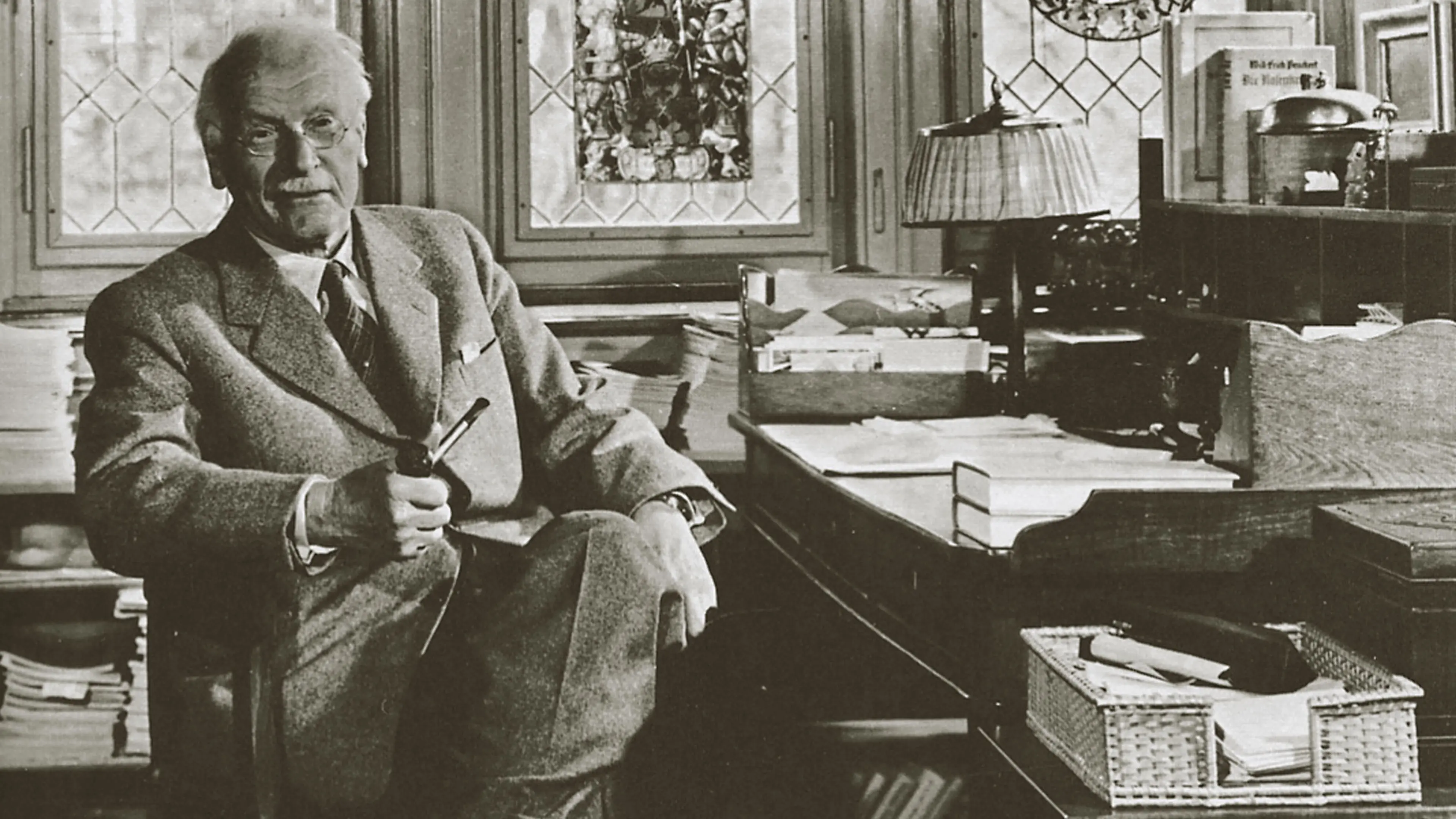
First, who the hell is Carl Jung
Quick sidebar for anyone who doesn't know, because this whole thing collapses without him.
Swiss psychiatrist, born 1875. He started out as Freud's golden boy. Freud literally called him his crown prince and wanted him to inherit psychoanalysis. Then they fell out around 1913 over, roughly, whether everything is about sex. Freud said yes. Jung said there's more going on down there. The breakup wrecked him. He spent years having what he called a confrontation with the unconscious, which is a clinical way of saying he had visions, talked to figures in his head, and painted them into a giant red leather book that his family hid for decades because it made him look insane. It's called The Red Book. It's real. You can buy it.
While recovering from that he also had a very public and very messy situation with his patient turned colleague Sabina Spielrein, and Freud got dragged into the fallout by post. This is not relevant to MBTI, I just want you to know this man was a mess.
Out of all that he built his own school, analytical psychology, and gave the world a bunch of words you already use without knowing they're his. Introvert and extravert. Archetype. The collective unconscious. Persona. Synchronicity. Complex, as in "she's got a complex". The shadow, which every TikTok therapist now sells back to you as shadow work. Even Alcoholics Anonymous partly traces back to a letter he wrote to its co-founder saying the cure for drink was a spiritual experience.
He read alchemy, Gnostic texts, the I Ching, Tibetan Buddhist stuff, and treated all of it as data about the psyche. He was not a scientist in the lab coat sense and never pretended to be. He was a mystic with a medical degree and a very good filing system.
The book
Back in 1921, Carl G. Jung published Psychologische Typen. Eight years of silence, then a brick of a book that opens with Gnostics, early church fathers arguing about whether the Eucharist is literally Jesus, and Plato vs Aristotle. Jung's take: those weren't theological fights. Those were introverts and extraverts being unable to stand each other for two thousand years. Iconic.
He wasn't trying to build a quiz. He was trying to work out why he and Freud and Adler could look at the same patient and see three different people. His answer was: because you see through your type, and your type is a limit, and the work of a life is to grow past it.
He came up with eight types. Not sixteen. Eight. And he wrote, more or less, that every individual is an exception to the rule and you can't describe a type in a way that fits more than one actual human. So the guy who invented the framework put a disclaimer on it saying please don't do the thing you're about to do.
They did the thing.
The mum with a baby laboratory
Enter Katharine Cook Briggs. Born 1875, same year as Jung, which is a fun coincidence I'm not going to do anything with. Went to college at fourteen, graduated top of her class. Married a physicist. While he did his PhD she set up what she personally called a "cosmic laboratory of baby training" in their living room. The baby was her daughter Isabel. Isabel was the subject. She had a method for raising her called Obedience-Curiosity, which sounds like a Bloodborne stat.
Katharine wanted to write fiction and her characters were flat, so she tried to figure out how people work by sorting everyone she knew into four buckets. Social, executive, spontaneous, meditative. Then in 1923 Jung's book got translated into English and she lost her mind. Wrote him letters. Went to see him speak at Harvard and wrote a song about it on the way. And per Merve Emre, who went through the actual archives for her book The Personality Brokers, Katharine also wrote erotic fanfiction about Carl Jung.
I need you to sit with that. The woman at the root of your dating profile personality type was writing Jung x Reader.
Her papers are at Michigan State right now. Folders titled Religious Experiments, The Modernization of God, and a set of index cards where she and her husband logged their dreams. This is not a psychologist. This is someone who found a book and made it a religion. Emre says it straight: Katharine took Jung as a personal religion, Isabel took him as a practical tool. That one sentence is the whole story.
The daughter who wanted a job for it
Isabel Briggs Myers, born 1897, homeschooled by the cosmic laboratory, went to Swarthmore for political science, married a guy called Chief. She wrote murder mysteries. Her first one won a prize in 1929. Then the career kind of just didn't happen, and Emre calls her a failed mystery novelist, which is mean but also lowkey me.
- Wartime. Factories need bodies and nobody knows where to put them. Isabel writes to Edward Hay, an HR consultant in Philadelphia whose whole deal was finger dexterity tests for clerks. She pitches him something bigger: what if you could know what a man is like, so you could work with him, work under him, or slot him into the right job. Hay says yes. The MBTI is born as a sorting tool for war labour. Not self-discovery. Logistics.
Then she hustled like a founder with no funding. Gave the test to her son's high school class. To college kids nearby. To military units of family friends. Her dad used his contacts to get it into the incoming class at George Washington University medical school, and from there she tested thousands of med students and used the data to tune it. It was reportedly used by the OSS to screen spies, which is the sort of thing every personality test claims and I couldn't verify at source, so take it as vibes.
Two things nobody tells you. One, Jung had three axes. The fourth one, J/P, the one the entire internet uses to explain why you're late, was invented by Isabel. Two, Katharine didn't understand the statistics her daughter was doing and asked to have her name taken off it. Isabel said no. So it's Myers-Briggs because a daughter refused to let her mum delete herself, which is the only wholesome part of this and I'm choosing to protect it.
Meanwhile Jung was complaining
From the mid 1930s until he died, Jung kept saying people had misread his book. For him, being a type was the problem. A one-sided way of living that you were meant to grow out of using something he called the transcendent function. Isabel's fix was the auxiliary function, which balances you a bit but keeps you inside your box.
So. A book about escaping your type got turned into a system for committing to one. Then in 1950 he apparently wrote a letter being somewhat nice about Isabel's version, so he doesn't even get to be a clean martyr here. Nobody in this story is.
The bit where it stops being real
The Educational Testing Service picked it up in the 50s, published the first manual in 1962, then dropped it. A company now called The Myers-Briggs Company took over in 1975 and that's when it became a Fortune 500 team-building ritual.
And then the science came in and it was not kind. Take it twice a few weeks apart and somewhere between 39% and 76% of people get a different type. The theory says each scale should have two humps, introverts here, extraverts there. The data has one hump. Everyone's on a slope and the test draws a line through the middle and tells the people standing on the line that this is their identity. The four scales map onto four of the Big Five traits, badly, and it has no Neuroticism scale at all. It skips the one trait that predicts the most about how your life goes. Very convenient for a workplace tool.
Here's the part that's actually funny though. You didn't take the MBTI.
The test you took was 16Personalities. That's not the MBTI. It's a Big Five test built by a company in Lithuania called NERIS, and by their own description they borrowed the four letter format from Myers-Briggs because it's simple and convenient. They added an A/T scale at the end, Assertive or Turbulent, which is Neuroticism wearing a fake moustache. Over a billion tests taken. The entire Korean MBTI moment, the "너 T야?" meme, idols announcing their letters, the sold-out Kakao T-shirts, runs on a test that isn't the thing it's named after.
So the lineage goes: Jung writes a book about not being a type. A mother treats it as scripture. A daughter turns it into a wartime job sorter. A corporation licenses it. A startup rebuilds it on a different theory but keeps the letters because the letters are the brand. And now it's a filter on Hinge.
Every single generation kept the vocabulary and swapped the substance.
What it actually is
I don't think MBTI survived because it's true. I think it survived because it's speakable. Four letters is a compression format for a self. Jung handed people a mirror and it was heavy and weird and full of Gnostics. Isabel handed them a label. 16Personalities handed them a card they could screenshot.
I say this as someone who has typed myself at least four times and gotten three answers. The letters were never the point. The wanting to be legible to yourself was the point. That part is a hundred years old and it's not going anywhere.
Anyway. Your INFJ is a Lithuanian Big Five score in a costume designed by a woman who wrote Jung smut. You're welcome.
Where I got all this
- Carl Jung — Encyclopaedia Britannica, for the biography and the Freud split
- The Red Book: Liber Novus — the Philemon Foundation, who funded getting it out of the family vault
- Sabina Spielrein — Jewish Women's Archive
- Jung's letter to Bill Wilson, 1961 — the spiritus contra spiritum letter, full text
- Psychological Types (1921) — the eight types, and Jung's own disclaimer
- Merve Emre, The Personality Brokers — the whole Katharine and Isabel story, from the archives. Her Longreads interview is the short version
- Katharine E. Cook Briggs papers, UA 10.3.68 — Michigan State University Archives, where the dream cards actually live
- Edward N. Hay and Isabel Briggs Myers
- The MBTI's publishing history — ETS 1962, handover in 1975
- Goodbye to MBTI, the Fad That Won't Die — Adam Grant, for the retest numbers and the one-hump problem
- Our Theory — 16Personalities saying it themselves: "We use the acronym format introduced by Myers-Briggs for its simplicity and convenience", and "we have not incorporated Jungian concepts"